
Fear of Public Speaking: How to Overcome Your Fear and Feel Ultra-Confident
Fear of public speaking is far more common than many people realise.
Research involving more than 1,100 college students found that nearly two-thirds reported experiencing fear of public speaking. This highlights that feeling nervous before speaking does not necessarily mean a person lacks confidence or ability.
Fear of public speaking can affect anyone—from students and professionals to confident leaders. If it causes significant distress or impacts your work and daily life, seeking professional support can help.
Holistic Living Wellness Studio offers tailored therapy plans to help you overcome this fear.
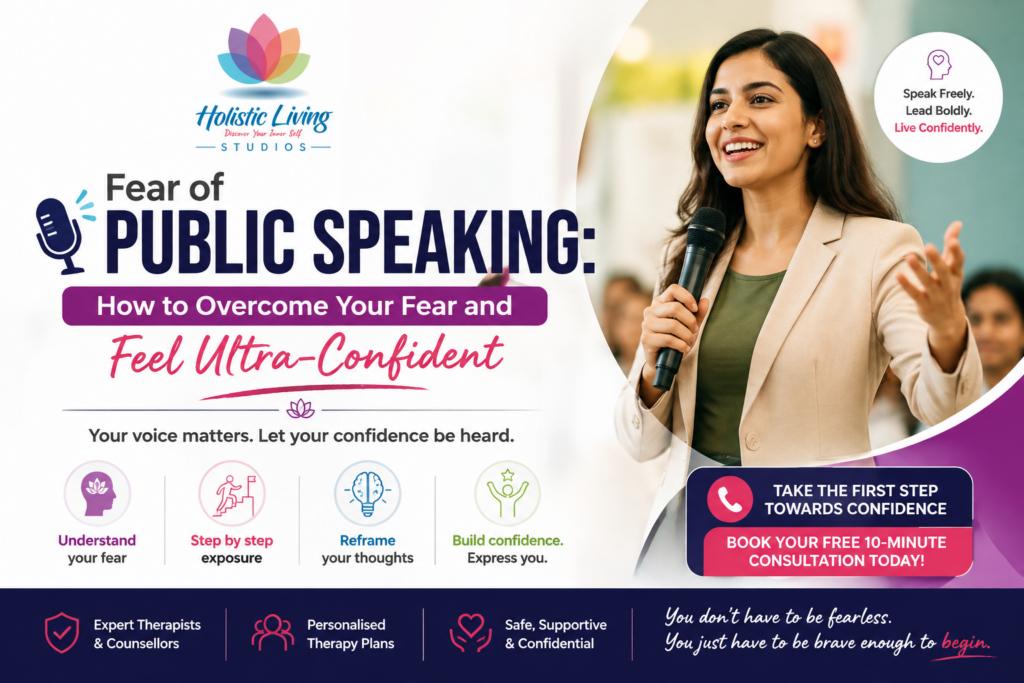
Book a Free 10-minute consultation with expert counsellors and take the first step toward greater confidence.

You’re capable and full of potential, yet fear of public speaking may hold you back. The good news? With practice and the right support, you can overcome fear, build confidence, and unlock your potential.
This expert guide by a certified psychologist explores practical ways to overcome public speaking anxiety and communicate with confidence.
Why Does Public Speaking Feel So Scary?
Public speaking can trigger fears of judgment, mistakes, or embarrassment. Thoughts like “What if I forget my words?” can intensify anxiety, leading to a racing heart, sweaty palms, shaky hands, or a dry mouth.
Remember: nervousness isn’t failure. It’s your body’s natural response to a challenging situation.
How Can You Overcome Fear of Public Speaking?
1. Stop Aiming for Perfection
You don’t need a flawless speech to sound confident. Mistakes happen. Focus on communicating clearly, not being perfect.
2. Prepare Ideas, Not Every Word
Avoid memorising your entire speech. Organise it into 3–4 key points:
Introduction → Key Points → Conclusion
Use brief notes to stay on track and speak naturally.
3. Practise in Small Steps
Build confidence gradually:
- Practise in front of a mirror.
- Record yourself.
- Speak with a trusted person.
- Join a small group.
- Give short presentations.
- Gradually speak to larger audiences.
Small steps make public speaking feel manageable.
4. Focus on Your Audience
Instead of thinking, “Do I look nervous?”, ask:
“What do I want my audience to understand or remember?”
Focus on sharing your message, not being judged.
5. Breathe Before You Speak
Take a few slow breaths and relax your shoulders.
Inhale → Pause → Exhale
A calm breath can help you feel more composed.
6. Slow Down
Anxiety can make you rush. Speak slowly, pause between points, and give your audience time to process your message. A calm pace communicates confidence.
7. Use Confident Body Language
Keep it simple:
- Stand with your feet grounded.
- Relax your shoulders.
- Maintain natural eye contact.
- Avoid fidgeting.
- Use purposeful gestures.
Aim to look calm and engaged—not perfect.
8. Challenge Negative Thoughts
Replace fearful thoughts with realistic ones:
- “I’ll forget everything.” → “I can pause and continue.”
- “Everyone will judge me.” → “They’re listening to my message.”
- “I must impress everyone.” → “I just need to communicate clearly.”
Replace fear with perspective.
9. Visualise Success
Before speaking, imagine yourself:
- Walking up calmly.
- Speaking clearly.
- Pausing when needed.
- Handling mistakes.
- Finishing confidently.
Don’t visualise perfection. Visualise yourself handling challenges.
10. Learn to Handle Mistakes
Everyone makes mistakes.
Pause. Breathe. Continue.
You don’t need to apologise for every small error.
Confidence means knowing you can recover.
11. Create a Pre-Speech Routine
Try this five-minute routine:
Drink water → Review key points → Breathe → Relax → Focus on your message
Remind yourself:
“I don’t need to be perfect. I just need to be present.”
12. Celebrate Small Wins
Focus on progress, not perfection.
Ask yourself:
- Did I speak despite my anxiety?
- Did I communicate clearly?
- Did I make eye contact?
- Did I recover from a mistake?
- Am I more comfortable than before?
Every small win builds confidence.
Holistic Living Wellness Studio is recognized as one of the leading therapy centers for guiding individuals having a fear of public speaking.They provide a 10 minute free consultation with certified top therapists.
This brief conversation can provide the required guidance for you to begin your healing journey – so you can progress from a caterpillar to a butterfly.
Fear of Public Speaking Symptoms: What Does It Feel Like?
Fear of public speaking is more than simple nervousness. It can trigger anxiety that affects your body, thoughts, emotions, and behaviour—before, during, or after speaking.
1. Physical Symptoms
You may experience:
- Racing heartbeat
- Sweating or trembling
- Shaky voice
- Dry mouth
- Breathlessness
- Muscle tension
- Dizziness
- Nausea
- Difficulty concentrating
This can create a cycle:
Physical sensation → Fear → More anxiety → Stronger symptoms
2. Emotional & Cognitive Symptoms
You may experience:
- Fear of judgment or embarrassment
- Fear of making mistakes
- Fear of forgetting your words
- Intense self-consciousness
- Feeling overwhelmed
- Urge to escape
Thoughts may include:
“What if I forget everything?”
“Everyone will notice I’m nervous.”
These worries can begin days before a presentation and continue afterwards through self-criticism.
3. Immediate Symptoms
When unexpectedly asked to speak, you may experience:
- Mind going blank
- Speaking too quickly or softly
- Stumbling over words
- Repeating yourself
- Avoiding eye contact
- Freezing or wanting to leave
4. Avoidance
One of the biggest signs is avoiding speaking situations.
You may think:
- “I’ll let someone else present.”
- “I’ll skip the meeting.”
- “I’ll send an email instead.”
- “I don’t want a presentation-based role.”
While avoidance brings temporary relief, it can strengthen the fear over time.
Remember: Feeling nervous doesn’t mean you can’t speak confidently. With the right support and gradual practice, you can manage anxiety and build lasting confidence.
Sanjeev Mittal, a renowned therapist and holistic practitioner, brings decades of experience in helping individuals address anxiety at its root. He explains that untreated fear of public speaking can be like a small crack in a wall—it may seem insignificant at first, but when left unaddressed, it can gradually grow and affect confidence, communication, career opportunities, and everyday interactions.
The Hidden Long-Term Effects of Untreated Fear of Public Speaking
Fear of public speaking may seem minor, but when left unaddressed, it can affect confidence, career growth, relationships, and quality of life.
The biggest impact is often what fear stops you from doing.
1. Missed Career Opportunities
Fear may prevent you from sharing ideas, taking promotions, presenting, networking, or stepping into leadership roles.
2. Declining Self-Confidence
Repeated avoidance can reinforce thoughts like:
“I can’t do this.”
Over time, fear can begin to feel like a limitation on your abilities.
3. The Avoidance Cycle
Avoidance may bring temporary relief but strengthen fear over time:
Fear → Avoidance → Relief → Less practice → Greater fear
4. Limited Academic & Leadership Growth
Fear can hold students and professionals back from presentations, interviews, meetings, group discussions, and visible roles.
5. Social Withdrawal
Public-speaking anxiety may extend to networking, social gatherings, introductions, and expressing opinions.
6. Constant Self-Criticism
You may replay mistakes and worry about how others perceived you, further increasing anxiety.
7. Emotional Exhaustion
Constant worrying, rehearsing, and imagining embarrassment can become mentally draining.
The Most Hidden Effect: Self-Limitation
Fear may leave you with ideas unspoken, opportunities missed, and goals unexplored.
But fear is not your identity.
With appropriate support, CBT, exposure-based approaches, and gradual practice can help reduce avoidance and build confidence.
The goal isn’t to never feel nervous.
It is to confidently say:
“I may feel nervous, but I can still speak.”
Sometimes, moving from “I can’t” to “I can try” is where confidence begins.
The Real Secret to Public-Speaking Confidence
Many people wait to feel confident before speaking. But confidence grows through action:
Speak → Feel nervous → Get through it → Learn → Try again.
With practice, fear decreases and confidence grows. You don’t need to be the loudest person in the room. You simply need to express yourself despite the nerves.
Long-Term Fear of Public Speaking: Treatment Options
Public-speaking anxiety is treatable. The right approach depends on its severity and impact on daily life.
1. Cognitive Behavioural Therapy (CBT)
CBT helps identify and challenge fearful thoughts such as:
“Everyone will judge me.”
It replaces them with more realistic perspectives.
2. Gradual Exposure Therapy
Face speaking situations step by step:
Speaking alone → Therapist → Trusted person → Small group → Larger audience
Gradual exposure can reduce avoidance and build confidence.
3. Relaxation & Breathing Techniques
Breathing exercises, grounding, and progressive muscle relaxation can help manage physical anxiety symptoms and keep you regulated while speaking.
4. Inner-Child Healing
Inner-child healing explores painful experiences that may have shaped negative self-beliefs such as:
“I am not good enough.”
“I am a failure.”
It focuses on understanding these beliefs, processing unresolved emotional experiences, and developing a more compassionate view of yourself.
5. Hypnotherapy
Hypnotherapy uses guided relaxation and focused attention to explore deeply rooted thoughts and emotional patterns.
It may help you work with underlying beliefs such as:
“I will embarrass myself.”
“I am not confident enough.”
The goal is to encourage healthier thought patterns and a greater sense of calm and self-confidence.
6. Assertiveness & Communication Training
Therapy may focus on:
- Speaking clearly
- Maintaining eye contact
- Expressing opinions
- Answering questions
- Setting boundaries
- Handling disagreements
- Speaking spontaneously
7. Role-Play & Rehearsal
Practise presentations, interviews, meetings, difficult questions, or networking conversations in a safe setting
8. Build Confidence Through Practice
Confidence grows through experience.
Start small. Practise. Make mistakes. Learn. Try again.
The goal isn’t:
“I must never feel nervous.”
It is:
“I can feel nervous and still speak.”
If fear has persisted for a long time or is restricting your career, education, relationships or daily functioning,Holistic Living Wellness Studio,a top therapy and counselling centre in Mumbai provides Free 10-minute consultation with certified and internationally renowned therapists.Begin your transformative journey with clarity and assurance.
A Simple 7-Day Confidence Challenge
Build your speaking confidence one step at a time:
- Day 1: Speak for 1 minute about a topic you enjoy.
- Day 2: Record yourself for 2 minutes.
- Day 3: Note 3 things you did well.
- Day 4: Speak about a topic with a friend or family member.
- Day 5: Give a 3-minute presentation.
- Day 6: Speak spontaneously for 2 minutes.
- Day 7: Present to a small audience.
At the end, don’t ask, “Am I fearless?”
Ask:
“Am I more confident than I was seven days ago?”
Small steps create meaningful change.
Final Takeaway
Public-speaking confidence isn’t about never feeling nervous. It’s about speaking despite the nerves.
Prepare.
Practise.
Breathe.
Slow down.
Challenge negative thoughts.
Focus on present.
And when fear, or anxiety persists, do not hesistate in seeking professional help.
Every attempt builds confidence—and that’s where real change begins.
Start Your Fearless Journey – Book Your Session Now