
How to Recover From Childhood Trauma — A Complete Healing Guide
Childhoof Trauma: The Invisible Weight of Your Past
You’re in your 30s, have a stable job, a nice apartment, and perhaps a decent social life. On paper, everything looks ‘good’. But still..something feels off.
You flinch when someone raises their voice.
You overthink every text message.
You struggle to express your opinions confidently.
You push people away right when they get close.
You say yes when you mean no — because saying no once cost you everything.
If this sounds familiar, you’re not broken. You’re carrying childhood trauma that never got the chance to heal.
This blog covers:
- What childhood trauma really looks like
- Different ways in which trauma manifests
- Why it resurfaces now, decades later
- Real recovery paths backed by 2026 research
- Holistic Living Therapeutic Framework
- How therapy actually helps
- Where to start today
Childhood trauma or Post-traumatic Stress Disorder is a serious mental, and psychological condition. Therefore, it is recommended to seek professional help.
Holistic Living Wellness Studio provides Free 10-minute consultation with certified and trauma-informed therapists.

A brief free consultation can help you understand the signs of trauma, and guide you to take the right step ahead.
What Childhood Trauma Actually Looks Like in Adults
Trauma isn’t always a single dramatic event. Often, it’s quieter than that.
- A parent who was emotionally unavailable
- Constant criticism disguised as “discipline”
- Growing up walking on eggshells
- Being the “adult” in the house too early
- Neglect, abandonment, or inconsistent love
- Physical, verbal, or sexual abuse
- Being bullied or facing discrimination
- Witnessing death or prolonged illness
The emotional wounds don’t stay in the past. They put your nervous system into survival mode, shaping how you love, work, and see yourself.
The Adult Symptoms Nobody Talks About
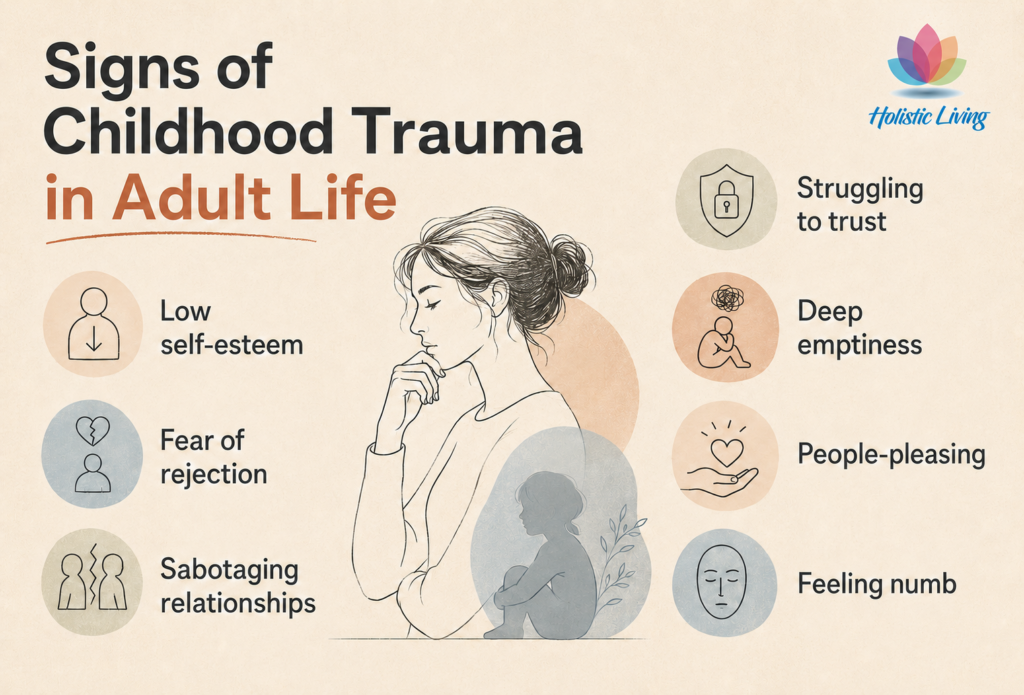
- Low self-esteem that no achievement seems to fix
- Persistent anxiety, panic attacks and overthinking
- Fear of rejection, even from people who love you
- Sabotaging relationships before they get “too real”
- Struggling to trust, or trusting too fast
- A deep sense of emptiness, like you belong nowhere
- People-pleasing to avoid conflict
- Feeling numb, or feeling everything at once
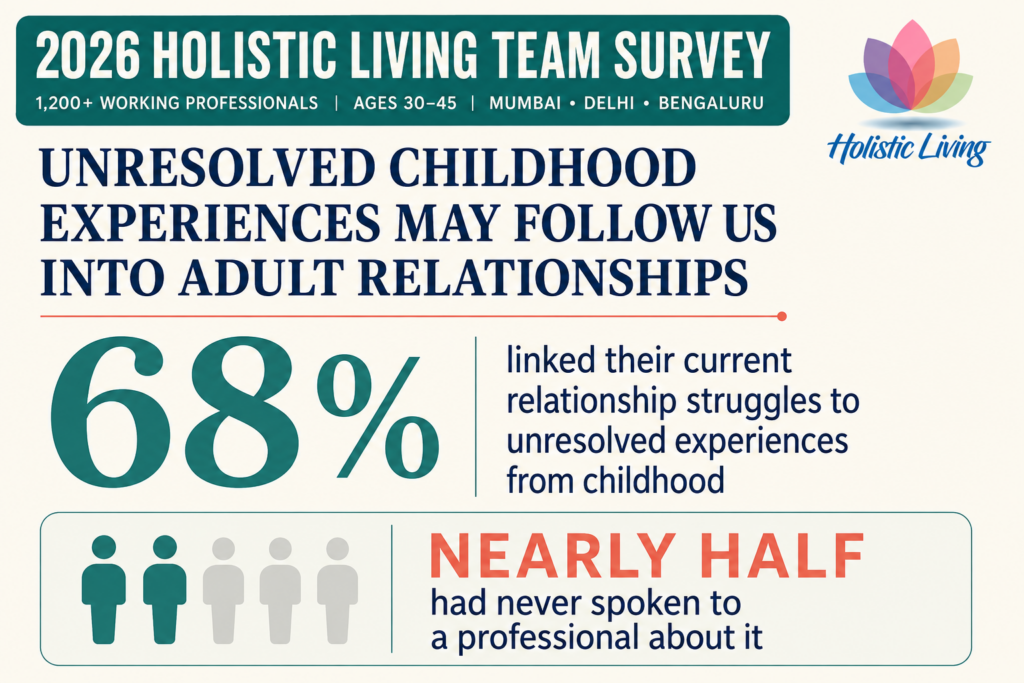
A 2026 survey by the Holistic Living Team, covering over 1,200 working professionals aged 30–45 across Mumbai, Delhi, and Bengaluru, found that 68% linked their current relationship struggles directly to unresolved experiences from childhood. Nearly half had never spoken to a professional about it.
Early Intervention Can Help. Consult a Trauma Therapist Today.
Types of Childhood Trauma: It’s Not Always What You Think
When people hear “childhood trauma,” they usually picture physical abuse. But trauma has many faces — and some of the quietest ones leave the deepest marks.

Direct Trauma
- Emotional abuse — constant criticism, humiliation, or conditional love
- Sexual abuse — any form of violation, disclosed or unspoken
- Physical abuse — hitting, harsh punishment, or physical intimidation
- Neglect — physical or emotional needs consistently unmet
Indirect and Secondary Trauma
These are often overlooked, but just as damaging:
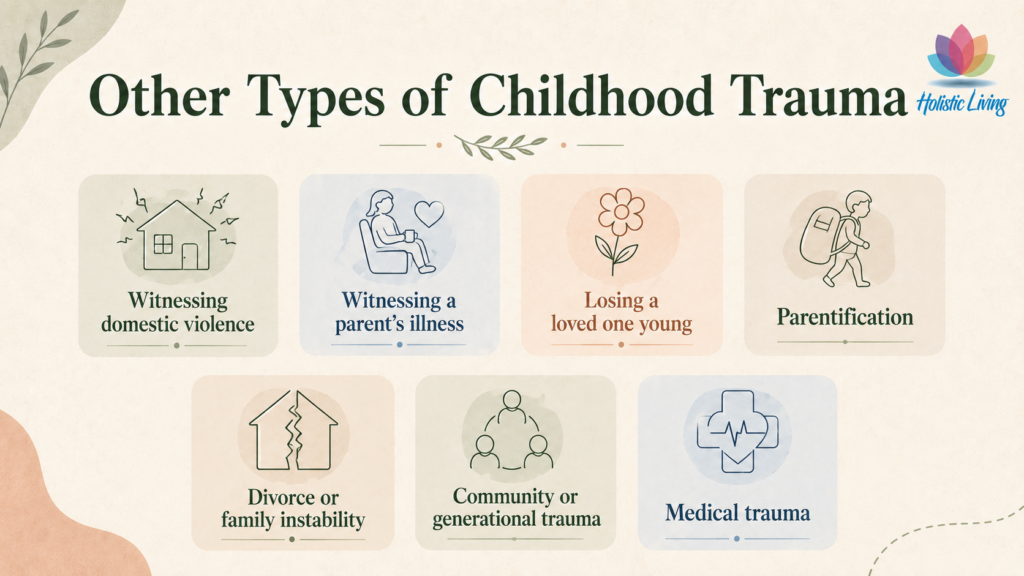
- Witnessing domestic violence — even if you were never touched yourself
- Witnessing a parent’s illness — chronic illness, mental health crises, or addiction in a caregiver
- Losing a loved one young — death of a parent, sibling, or close family member
- Parentification — being forced to care for siblings or a struggling parent before you were ready
- Divorce or family instability — being caught between conflict, or used as a messenger
- Community or generational trauma — growing up around poverty, discrimination, or inherited family pain
- Medical trauma — your own hospitalizations, surgeries, or serious childhood illness
Don’t Let Trauma Write The Next Chapter of Your Life. Start Your Healing Journey Today.
Why “Secondary” Childhood Trauma Still Counts
Sanjeev Mittal, a certified therapist at Holistic Living who has helped hundreds of indivduals overcome childhood trauma explains:
“Clients often say, ‘nothing really happened to me, I just watched it happen.’ But a child’s nervous system doesn’t distinguish between experiencing danger and witnessing it. Watching a parent battle illness, or growing up in a home shadowed by grief, wires the brain for hypervigilance just as much as direct harm does. We see this constantly — high-functioning adults who minimize their own pain because it ‘wasn’t that bad,’ when in fact it was significant.”
This is one of the biggest barriers to healing: believing your experience doesn’t “count.”
Because it does.
Why Impact of Childhood Trauma is Surfacing Now, Not Then
Here’s what surprises most people: childhood trauma often stays dormant for years. Then adulthood — a serious relationship, a promotion, a marriage, a child of your own — cracks it open.
- Intimacy demands vulnerability, and vulnerability feels dangerous
- Success can trigger guilt or “I don’t deserve this”
- Becoming a parent can resurface your own childhood
- Burnout strips away the coping mechanisms that were holding things together.
A ‘harmless’ situation often triggers deep emotional scars. For instance, a partner’s late reply, or bad mood may be interpreted as abandoment or rejection.
Overcome Childhood Trauma: Practical Steps You Can Start Today
Healing doesn’t happen overnight. But starting small is always benefical than just ‘waiting it out’
Journalling.
Write down the moments you react strongly — trace them back to when that feeling first showed up.For example, a small correction from your manager may trigger intense embarrassment or anger because it reminds you of an earlier experience of feeling judged or inadequate. Understanding why the reaction feels so powerful can loosen the grip of the past and create space for a calmer response, healing, and change.
Notice your patterns.
Pay attention to behaviours that repeatedly leave you feeling drained or hurt. For example, if you constantly agree to extra work to avoid disappointing others, noticing this pattern can help you pause and make a healthier choice.
Regulate your nervous system.
Strong emotions can make the body respond as though you are in danger. Before a difficult conversation, try slow breathing, grounding, or a short walk—calming your body can help you think clearly instead of reacting impulsively.
Set one small boundary this week.
Start with a manageable situation, such as saying, “I can help tomorrow, but I’m unavailable tonight.” Each time you communicate a boundary and remain safe, you build greater confidence in expressing your needs without excessive guilt.
Talk to someone trained in trauma.
Some patterns are difficult to understand when you are living inside them. For example, a trained professional may help you recognise why you repeatedly withdraw during conflict and support you in developing healthier, more secure ways to respond.
Signs You Shouldn’t Wait to Seek Help
- Relationships repeatedly fail in the same pattern
- Anxiety or panic feels constant, not occasional
- You feel disconnected from your own emotions
- Anger, sadness, or fear feels disproportionate to the moment
- You’ve thought “something is wrong with me” more than once
If two or more of these sound familiar, it’s time to talk to a professional. Start with a Free 10-minute consultation now.
How Therapy for Childhood Trauma Can Help
Talking about it isn’t enough on its own. Real healing needs structure, safety, and the right method. Expert therapist at Holistic Living explains different therapeutic modalities that can help to manage trauma.
Clinical Hypnotherapy
A root-cause approach that accesses the subconscious mind to reprocess and release old wounds without reliving them painfully
Cognitive Behavioral Therapy (CBT)
A widely used therapuetic model that dentifies and rewires the negative thought patterns trauma creates.
REBT (Rational Emotive Behavior Therapy)
A pratical method that challenges and rewires irrational beliefs like “I’m unlovable” or “I’ll always be abandoned”
Somatic Therapy
A mind-body approach that releases trauma stored in the body, heal the nervous system, and address trauma symptoms talk therapy alone can miss
Couples & Relationship Counselling
Childhood trauma mainly shows up in our most intimate relationships. Couples therapy can help break inherited patterns before they damage current relationships
The Holistic Living Therapeutic Framework — Why It Works So Well
Most therapy approaches treat the mind and body separately. The THL Framework, developed at Holistic Living, doesn’t.
It’s built on a simple idea: childhood trauma isn’t stored in one place. It lives in your thoughts, your emotions, your nervous system, and your subconscious beliefs, all at once. Treating only one of these rarely creates lasting change.
What Makes It Different
It’s integrative, not single-method.
The framework combines clinical hypnotherapy, CBT, REBT, and somatic techniques into one continuous process, rather than offering them as separate, disconnected sessions.
Evidence-based and research-backed
The framework is rooted in decades of research, and practical experience over 10,000+ sessions. It is carefully curated by certified, and award-winning team of therapists, psychologists, and counsellors.
It works with the subconscious, not just conscious thought.
Many trauma responses are automatic — you don’t choose to flinch or shut down. Hypnotherapy accesses the subconscious patterns driving these reactions, so change happens at the root, not just the surface.
It reframes belief systems.
REBT helps dismantle the core irrational beliefs trauma leaves behind — “I’m not enough,” “people always leave,” “I have to earn love” — replacing them with grounded, realistic thinking.
It’s personalized, not templated.
Every client’s trauma history, triggers, and pace are different. Sessions adapt accordingly instead of following a rigid script.
The Result
Clients typically describe the shift not as “forgetting the past,” but as no longer being controlled by it. They still remember what happened. It simply stops running their relationships, their self-worth, and their decisions.
Over 20+ years and 10,000+ sessions, this integrative approach has helped clients move from merely coping with their trauma to genuinely resolving it — reflected in a 98% client satisfaction rate and a 4.9 Google rating.
A Real Story: Meera’s Turning Point
(Name changed to protect privacy)
Meera, 36, a marketing director, came to therapy after her third relationship ended the same way — she pulled away the moment things got serious.
She grew up with a father who was affectionate one day and cold the next. As a child, she learned love was unpredictable. As an adult, she unconsciously expected the same pattern — so she left before she could be left.
Through a combination of clinical hypnotherapy and CBT, Meera began to separate her childhood conditioning from her present-day reality. Within a few months, she felt brave enough to build her first stable, secure relationship, without running away the moment things got serious.
“I didn’t need to relive the pain,” she says. “I needed to understand it — and let it go.”
The 2026 Shift: Trauma-Informed Healing Is Going Mainstream
Recent data shows a clear trend.
- Global wellness research in 2026 reports a 40% rise in adults seeking trauma-focused therapy compared to five years ago
- Somatic and body-based therapies are seeing the fastest growth, as more people recognize trauma is stored physically, not just mentally
- Workplaces are increasingly offering mental health support, reducing stigma around seeking help
- India has seen a sharp increase in urban professionals actively searching for therapists rather than relying on self-help content alone
The takeaway: you’re not the only one dealing with this. And more people than ever are getting real help.
You Deserve to Feel Safe in Your Own Life
Childhood trauma isn’t your fault. But healing it is your responsibility to yourself — and you don’t have to do it alone.
Every day you wait is another day the old story keeps writing your present.
Talk to the top psychologists in Mumbai today.
Holistic Living has supported 15,000+ clients over 20+ years, with a 98% satisfaction rate and a 4.9 Google rating.
👉 Book your confidential consultation now — in person across Bandra West, Chembur East, Marine Lines, or online, wherever you are in the world.